How Treatment Centers Get More Qualified Leads: The Qualified-Lead Flywheel
Last updated: July 2026 · Reviewed by Aaraddhya Bhatalkar, Co-CEO, New Resilience.
Not every inquiry is worth the same. A center can generate hundreds of calls and still not fill beds if most callers need a different level of care, have no coverage, or aren't ready to start.
Where an inquiry comes from says a lot about whether it will convert. Across behavioral health programs, alumni referrals convert to admission at roughly three to four times the rate of cold online inquiries, and professional referrals at about twice. In rough numbers, alumni run around 25 percent, professional referrals around 15, and cold online around 7. Blended across every source, about one inquiry in nine becomes a client. Even within online, inquiries that arrive by word of mouth convert about double cold search.
That matches what healthcare marketers have found for years: referred patients convert several times better than cold web leads. A referral is a warm introduction from someone the person already trusts. A cold click is a stranger.
The best-converting sources, alumni and referrals, are usually the smallest and least managed. So the goal isn't more leads. It's more qualified admissions, and that comes from connecting the channels that produce them instead of running each one alone. We call it the Qualified-Lead Flywheel.
It connects five things most centers keep separate: the treatment experience, alumni relationships, reputation and referrals, online visibility, and admissions data.
Strong treatment experience → real alumni relationships → honest reviews, referrals, and insights → better visibility and trust → more qualified inquiries → more clients and future alumni.
Each part feeds the next. Run them in separate departments and you get activity without admissions.
Two kinds of inquiry stand above the rest, and for the same reason. Both come with trust already attached. A warm alumni referral is the highest-converting source a center has because it is a vote of confidence: someone who lived the program is telling a family it worked, which carries more weight than any ad. A high-intent GEO inquiry works the same way. A cold search click is a stranger typing keywords, but a GEO inquiry is a family who asked AI or search for help and got handed your name as the answer. People increasingly lean on ChatGPT, Gemini, Claude, and Grok the way they would a trusted friend, so when one of those tools points a family to your program, they arrive already inclined to believe it fits. Alumni referrals convert around 25 percent, and in 2026 studies from Semrush and Adobe, AI-referred visitors converted several times better than paid or cold search. As competition rises and paid costs climb, alumni and GEO are the two channels to build.
What each admission costs
Conversion is only half the story. The other half is what you pay per admission, and the gap there is just as wide. Alumni and referrals are the lowest-cost admissions channel a center has, and organic and local search sit right beside them. Paid channels cost multiples more: business development around twice, directories several times over, and paid search eight or nine times the cost of an alumni referral.
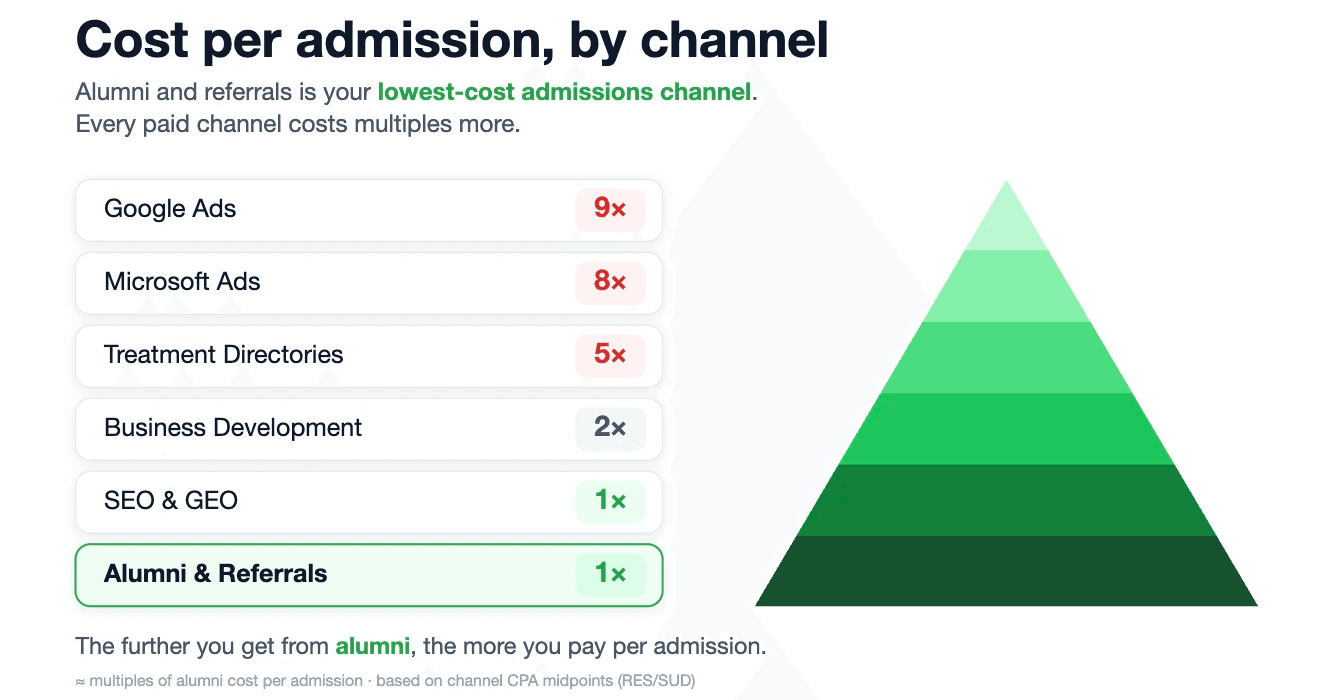
That is the economics behind the flywheel. The channels you own, alumni relationships and the content that makes you findable, cost the least and keep working after you build them. The channels you rent, ads and directories, cost the most and stop the day you stop paying. Alumni convert best and cost the least. GEO costs far less per admission and grows fastest. The two together are where the math points.
There is a deeper reason to lean on them: alumni and GEO compound. Each new group of alumni grows the base that refers the next, and every page and review you publish keeps working and makes the next one easier to rank. Ads and business development do not compound. Ads stop the day you stop paying, and business development needs constant touchpoints to hold steady and resets whenever a rep leaves. Alumni and GEO keep producing after the work is done. Ads and BD only pay while you keep feeding them.
Paid channels have one real advantage: speed. Ads can be live within a day and scaled as fast as you can spend, so when beds are empty this month, they are often the quickest way to fill them, even at a high cost per admission. Alumni and GEO work the other way. They take weeks or months to build, because reviews accumulate and content earns its ranking over time, but once they are working they keep producing at low cost. So timeline decides the mix. If you need heads in beds in the next few weeks, paid search is the practical tool. If you are planning census a year out, the same budget does more building alumni engagement and GEO, and paid spend can taper as those channels take hold.
What counts as a qualified lead?
A qualified lead is a prospect whose needs match what you can deliver: the level of care fits, you treat their condition, they're in your area, their coverage works, and they're ready or close to it.
An admit rate near 11 percent isn't a failure, it's normal. Most inquiries aren't a fit. The number that matters isn't how many people called, it's how many were right for the program and moved toward admission.
Why running these as separate efforts falls short
When marketing, admissions, business development, alumni, and clinical each work on their own, the information that would help the others stays put. Admissions hears the questions families ask. Clinical knows who fits. Alumni staff hear what former clients valued or misunderstood. Marketing sees which pages get traffic. Business development knows how referral partners describe you.
Kept separate, that produces generic content, poorly matched campaigns, alumni admissions nobody counts, and spend that buys activity instead of clients.
Step 1. Be clear about who you serve
You can't generate qualified leads without being clear about who the program is and isn't for. Be able to answer, consistently: which conditions and levels of care you offer, who isn't a fit, which payers you take, what admissions looks like, and what happens after treatment.
Keep those answers the same across the website, admissions, business development, your online profiles, and alumni communications. Clear criteria let prospects rule themselves in or out before they call. You get fewer inquiries, and more of them are real.
Step 2. Work alumni as your highest-converting channel
This channel matters more than it did five years ago. As competition has intensified, more programs keep patients inside their own continuum of care rather than referring them out, so the professional referrals a BD team can win have thinned. Your alumni are a referral source that does not depend on another facility choosing to pass a patient along, which is part of why they convert so well. We cover the wider shift in how treatment centers allocate a marketing budget.
Alumni referrals are the best-converting inquiries a center gets, around 25 percent, three to four times cold online. At most programs they're also a small share of total inquiries, often a few percent. It's the best channel and usually the least worked.
An alum who refers someone has been through the program. That's a warm introduction from someone the prospect trusts, and trust drives most of the decision. Healthcare consumers consistently say a recommendation from a friend or family member outweighs almost any advertising.
Alumni engagement only turns into referrals when it starts with support, not an ask. SAMHSA describes recovery as an ongoing process and points to peer support as a way to keep people connected after treatment. In practice that's post-discharge check-ins, peer and family groups, recovery events, and a clear path back to clinical help.
Our alumni product runs this at scale: check-ins, segmentation, consent tracking, and follow-up, without your team doing it by hand. It keeps the community you already built connected and makes the referrals that come out of it measurable.
Step 3. Learn from alumni, don't just market to them
An engaged alumni community is useful market research. Former clients and families can tell you what they searched for before choosing a program, what was hard to find, what almost stopped them, and how they describe you to others.
That feeds more than alumni programming. It informs your website, admissions scripts, FAQs, and referral materials, and it gives you the real questions to answer in content instead of guessing from a keyword tool.
Step 4. Turn those questions into content only you can write
Search engines and AI answers reward original, first-hand content over generic articles. Google's guidance for AI search features says the same: helpful, people-first content wins.
Anyone can publish 'What Is Residential Treatment?' Fewer can publish 'How our admissions team decides whether residential is the right call,' with the questions you ask, the factors you weigh, and when you refer out. The second one helps the reader more and gives an AI system a specific source to cite.
Step 5. Build reputation with real alumni voices, carefully
Prospects trust other clients more than they trust your marketing, so alumni and family voices carry weight your own pages can't. Reviews also affect local visibility; Google counts review volume and score among its local ranking factors.
Reviews in behavioral health need care. Ask for honest feedback, not positive reviews. Don't offer incentives, don't pressure anyone, use real experiences only, and don't script the rating. Google bans paid or fake reviews, and the FTC's Consumer Reviews and Testimonials Rule prohibits fake reviews and incentives tied to sentiment. Be careful replying, too. Even if a reviewer says publicly that they were treated with you, don't confirm or reveal anything protected. HHS has fined providers that exposed protected health information in review responses.
Step 6. Become the answer search and AI recommend
People are starting to find care through AI tools. ChatGPT, Gemini, Claude, and Grok now come up when admissions asks how someone heard about the program. In behavioral health the volume is still small.
The broader data is worth watching. In 2026 studies from Semrush and Adobe, visitors arriving from AI assistants converted several times better than organic or paid search, roughly four to five times, and stayed longer once they landed. The reason is intent: someone who described their situation to an AI and got pointed to you arrives already researched.
GEO, or generative engine optimization, is making your information clear and credible enough that AI systems and search engines understand you and recommend you. The programs that become the trusted answer now will benefit as the channel grows.
Our GEO service turns your alumni insights, admissions questions, and reputation into the content and structured data that AI and search cite.
Step 7. Turn visibility into qualified inquiries
Traffic only helps if the site lets the right person see the fit and the wrong person rule it out. Plain website inquiries are often the lowest-converting online source, well below referrals, usually because the pages aren't built to qualify anyone.
Make the deciding details easy to find: conditions and populations you treat, levels of care (residential, PHP, IOP), locations, insurance, family involvement, clinical leadership, and what admissions involves. Then match the next step to the person. Someone ready to admit needs a phone number. A parent researching needs a guide. A referring professional needs your criteria and a direct line.
Step 8. Measure the whole path, not the first click
You only see that alumni convert best, or that an AI tool sent a recent admit, if you tie each admission back to its source. Most centers can't, because the last click gets the credit. A family hears about you from an alum, reads reviews, asks ChatGPT, and calls after their therapist's recommendation, and the chain gets logged as one thing or nothing.
Track admissions and cost per viable opportunity, not traffic and call volume. Watch conversion by source and alumni-influenced admissions. Pick one attribution method, have admissions ask a neutral 'how did you hear about us,' and let more than one source count.
Step 9. Feed admissions data back in
Close the loop by feeding what you learn at admission back into content and outreach. Each quarter, look at which content brought in the best-fit clients, which alumni activities drove engagement, which referrals became admissions, and which channels had the lowest cost per admission. Adjust the next quarter's work from that.
Putting it together
A strong program earns alumni relationships. Those produce referrals, feedback, and honest reviews. The recurring questions and real experiences become content, which, with accurate business information and real reviews, makes the program easy for families, referrers, search engines, and AI to understand. More of the right people find it, admissions records what influenced them, and that shapes the next round.
That is the loop. Alumni engagement produces reviews and referrals. Those make you the answer search and AI recommend. That visibility brings more of the right families, and the ones who finish treatment become your next alumni, who produce the next round of reviews. Every turn makes the next one cheaper and easier.
This matters more as the field gets crowded. Paid channels only get more expensive as more centers bid for the same clicks and directory slots, and generic content gets harder to rank. Alumni relationships and GEO are the two channels a competitor cannot buy overnight. With competition rising, they are the right place to focus.
Frequently asked questions
How does a treatment center get more qualified leads? Define who you can and can't serve, then align the website, your profiles, admissions, referrals, content, and alumni engagement behind that definition. Measure qualified admissions, not traffic. Alumni referrals convert roughly three to four times better than cold online and professional referrals about twice, so the fastest gains come from the relationship channels.
Do alumni really generate better leads? Yes. Alumni referrals are the highest-converting source in behavioral health admissions, around 25 percent, three to four times cold online, and usually the smallest channel. It lines up with the long-standing finding that referred patients convert several times better than cold web leads.
What is GEO for treatment centers? GEO, or generative engine optimization, is making your information clear and credible enough that AI search and answer tools understand and recommend you. Families already find care through ChatGPT, Gemini, Claude, and Grok, and in 2026 studies from Semrush and Adobe, AI-referred visitors converted several times better than paid or organic search.
Should treatment centers focus on GEO or alumni engagement first? Both. Alumni engagement creates your highest-converting inquiries, and GEO brings the highest-intent ones online. They also feed each other: alumni reviews and questions make your GEO content credible, and GEO puts you in front of more of the right families. As competition rises and paid costs climb, these are the two channels worth building first.
New Resilience helps treatment centers work their highest-converting channels and get found by the families who need them. The alumni product scales the relationships that convert best, the GEO service makes you the answer search and AI recommend, and the CRM ties every admission back to its source so you can see what works. Book a demo to see it.